Seminar B / Step-Up Course on Effective Utilization of Welfare Equipment
- Venue
- Reception Hall B
- Date
- October 7 (Wed), October 8 (Thu)
- Pre-register
- Demonstrations
- Participation fee required
Eating / Canes & Walkers / Wheelchairs /Night-time Postural Positioning / Excretion (Bedsides) / Beds / Home Modification
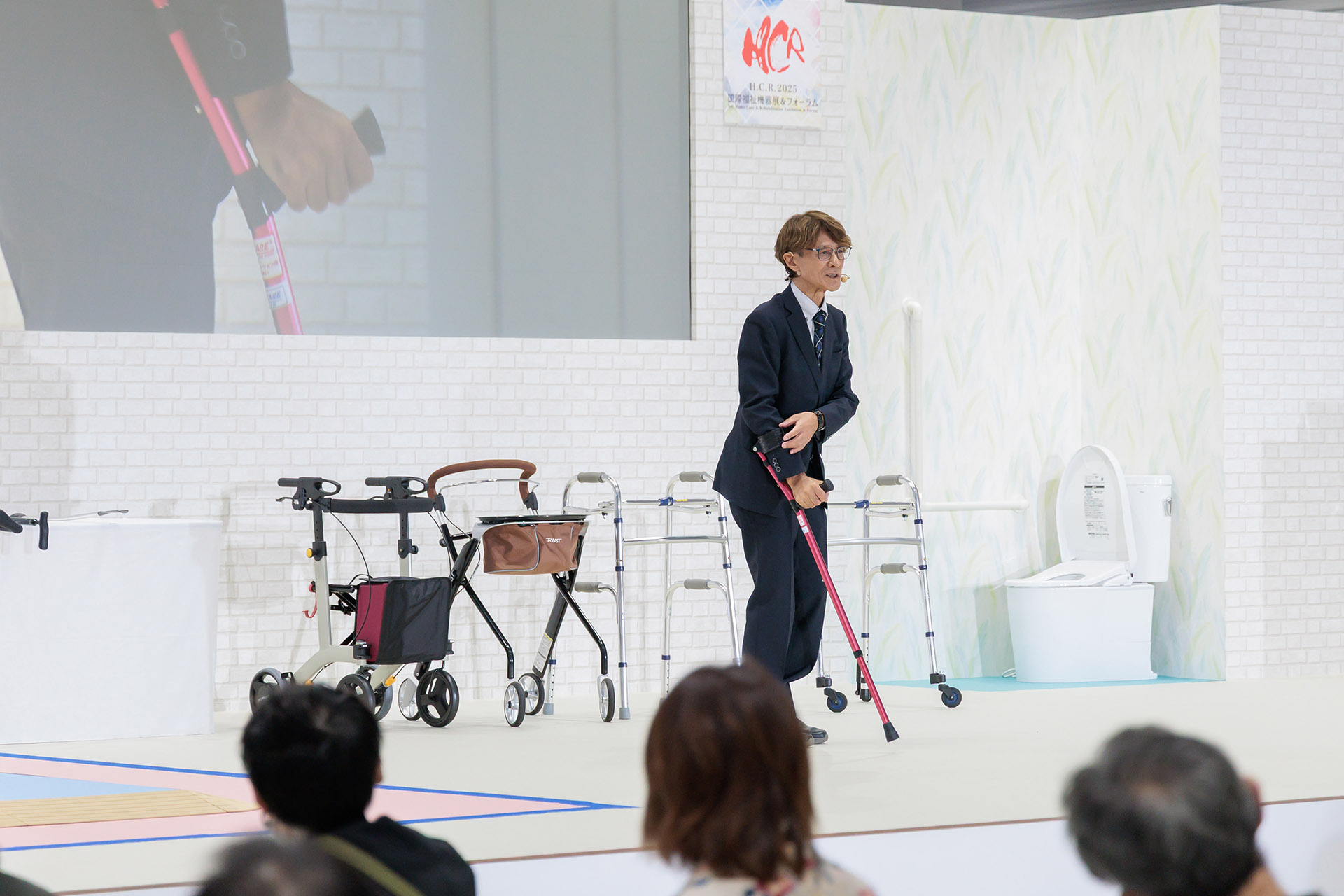
Featuring lectures with live demonstrations on a stage modeled after home living environments! Designed for professionals such as OTs, PTs, nurses, care managers, and welfare equipment consultants, this course demonstrates practical equipment usage for home environments. Attendees will receive a dedicated textbook (2026 Edition) of over 100 pages. Plus, attending even a single session grants access to the archived streaming of the introductory session, "Decision-Support and Welfare Equipment Utilization Required for Professionals." Anyone involved in care and support is encouraged to join us.
Participation Fee: 1,000 yen per session / Pre-registration Required
Introduction (Archived Streaming)
Speaker: Reiko Ishiyama (Professor, International University of Health and Welfare)
Decision-Support and Welfare Equipment Utilization Required for Professionals
[Lecture Overview]
One of the strengths of professionals is their ability to anticipate needs using high expertise. While this easily creates a natural desire to help or do something for the client, acting on unexamined good intentions risks falling into benevolent paternalism. The blind spots lie not only in situations requiring difficult decisions, but especially in everyday, typical scenarios. This lecture sheds light on the awareness and thinking of professionals recommending welfare equipment, exploring person-centered support, decision-support, and ACP (Advance Care Planning).One of the strengths of professionals is their ability to anticipate needs using high expertise. While this easily creates a natural desire to help or do something for the client, acting on unexamined good intentions risks falling into benevolent paternalism. The blind spots lie not only in situations requiring difficult decisions, but especially in everyday, typical scenarios. This lecture sheds light on the awareness and thinking of professionals recommending welfare equipment, exploring person-centered support, decision-support, and ACP (Advance Care Planning).
October 7 (Wed)
Speaker: Mamoru kashima (Director, Elderly Living Welfare Research Institute / Physical Therapist)
10:30–11:30 Canes & Walkers
[Lecture Overview]
Focusing on walking as a key means of mobility for humans, this session explores the roles of canes and walkers, differences in balance function, their usage characteristics, and key considerations for indoor use.
Speaker: Ryuichi Masunaga (Noge General Medicine and Neurology / Speech-Language-Hearing Therapist)
12:30-13:30 Eating
[Lecture Overview]
Offers practical advice for home care on preventing aspiration for individuals with dysphagia (swallowing difficulties). Topics include evaluating points dysphagia at home, practical thickening methods, mealtime posture/positioning, and seating techniques.
Speaker: Mamoru Kashima (Director, Elderly Living Welfare Research Institute / Physical Therapist)
15:00–16:00 Beds & Sleep Positioning
[Lecture Overview]
Starting from the fundamental question of what medical beds are truly designed for, this lecture will explore their roles not only as assistive technology for movements like sitting up, or as a tool to reduce physical strain—such as back pain—for caregivers during tasks like feeding and changing diapers, but also in relation to sleep, accident prevention, and positioning.
October 8 (Thu)
Speaker: Minako Makino (Board Member, NPO Japan Continence Action Society)
10:30–11:30 Excretory Care (Out of Bed)
12:00–13:00 Excretory Care (In Bed)
[Lecture Overview]
Excretory disorders have diverse causes and symptoms, with a high degree of individuality, and are strongly influenced by the values of both the individual and their caregivers. Moving away from the fixed idea that "incontinence automatically means diapers," this session emphasizes the importance of equipment tailored to bodily functions in order to support the lifestyle they desire. In the In-bed Care section, we will spend time reflecting together through case studies.
Speaker: Kyoko Horiie (Musashinosi Fukushikosha public interest incorporeted foundation / Occupational Therapist)
14:00–15:00 Wheelchairs
[Lecture Overview]
Wheelchairs are vital tools for achieving a desired lifestyle, requiring appropriate environmental setup and support. This session explains the balance between physical function, goals, and environment. Learn how small, cumulative improvements in physical care, adjustment features, transfer safety, and home environments build peace of mind and independence.
Speaker: Mime Hashimoto (Associate Professor, Faculty of Health Sciences Graduate School of Human Health Sciences, Tokyo Metropolitan University)
15:30–16:30 Home Modification
[Lecture Overview]
To help older adults live healthy lives at home, let’s consider creating environments for fall prevention. For those needing long-term care, adjusting the home environment to match their physical condition and mobility is essential. In preparation for such cases, professionals should possess the necessary knowledge of home modifications and environmental adjustments. This course explores the perspectives professionals should hold, how to evaluate the home environment, and the basic acquaintance of home modification. We will cover fundamental knowledge including handrails, step elimination, and room-by-room and action-specific guidelines.